

What Should Savannah Home Buyers Know About Polybutylene Plumbing?
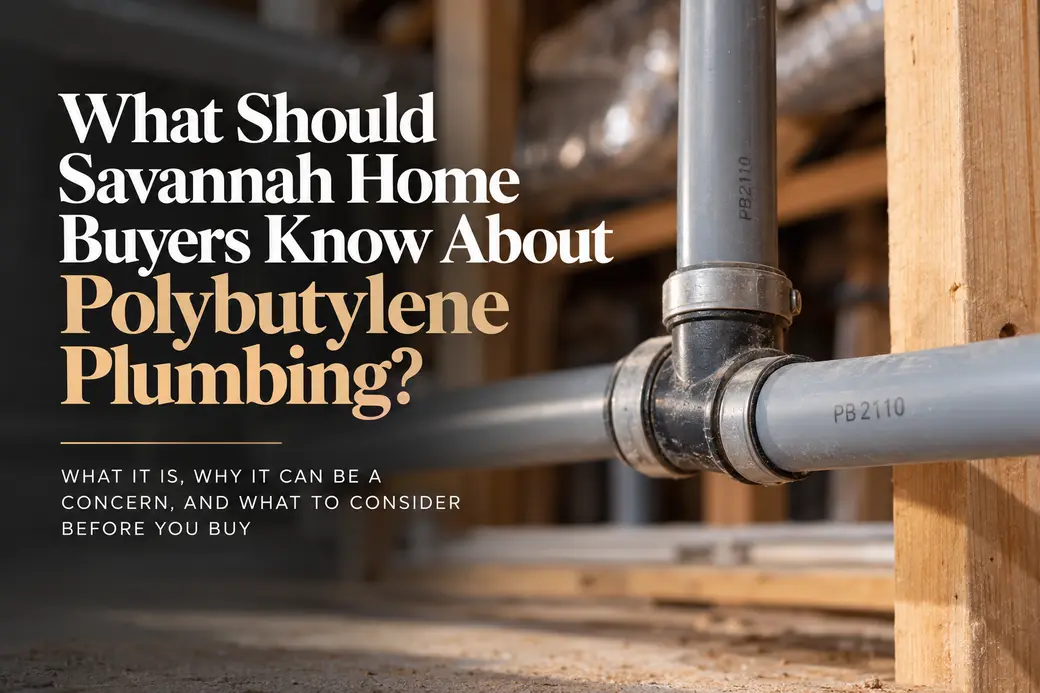
What Should Savannah Home Buyers Know About Polybutylene Plumbing?
Sometimes a home inspection uncovers something a buyer has never heard of before.
Polybutylene plumbing is one of those things.
It may look like an ordinary gray plastic water line. There may be no active leak. The seller may have lived in the house for years without a plumbing problem.
And then the inspection report identifies polybutylene, often abbreviated as PB, and suddenly the buyer is trying to figure out whether the house has a serious problem.
The short version is this:
Finding polybutylene plumbing does not automatically mean you should walk away from the house.
But it is also not something I would ignore.
Before deciding how to proceed, you want answers to three questions:
How much polybutylene is actually present?
What would it cost to address it?
Will it affect the buyer's homeowners insurance?
Once we have those answers, we can evaluate the property with facts rather than fear.
What Is Polybutylene Plumbing?
Polybutylene is a flexible plastic piping material that was widely used for residential water-supply systems from approximately 1978 through the mid-1990s.
It was attractive to builders and plumbers because it was flexible, relatively inexpensive and easier to install than some traditional piping materials.
InterNACHI reports that polybutylene was installed in millions of U.S. homes during that period. Production eventually stopped after widespread complaints and litigation involving leaks and plumbing failures.
That time period is important for Savannah-area buyers.
If you are purchasing a home built or substantially plumbed during the late 1970s, 1980s or early 1990s, polybutylene is one of the plumbing materials that may warrant additional attention during due diligence.
The age of the house alone, however, does not tell you what plumbing is actually present.
Homes get repiped.
Sections get repaired.
Additions may contain different materials from the original structure.
That is why the actual property needs to be evaluated.
What Does Polybutylene Look Like?
Polybutylene is most commonly associated with flexible gray plumbing lines, although it was also manufactured in other colors, including blue, black, white or silver.
One of the strongest identifiers is the marking:
PB2110
That marking may appear along the pipe itself.
Polybutylene was used for water-supply piping, not drain, waste or vent piping. Visible portions may sometimes be found near a water heater, under sinks, in a crawlspace, near the main water shutoff or where the water service enters the house.
Color alone is not enough to positively identify it.
Newer piping materials can also be gray, blue or other colors.
If there is a question about what material is present, you will want a licensed plumber to confirm it rather than make the decision based solely on appearance.
Why Is Polybutylene a Concern?
Polybutylene developed a documented history of leaks and failures.
One concern is that certain oxidants and disinfectants found in treated water can contribute to deterioration of the material. The degradation may occur within the pipe or at fittings and may not necessarily be obvious from looking at the outside of an accessible section.
That last part is important.
A buyer may look at an exposed piece of pipe and think:
“It looks fine.”
That does not necessarily tell us the condition of the entire system.
Much of a home's supply plumbing may be behind drywall, under floors, above ceilings or in other inaccessible locations.
A normal visual home inspection cannot see through those surfaces.
Does Every Polybutylene System Fail?
No.
The presence of polybutylene does not mean a plumbing failure is occurring or that one is guaranteed to happen.
In fact, the North Carolina Real Estate Commission revisited this issue in 2025 and specifically noted that not all - or even most - polybutylene systems with certain fittings necessarily fail. It also noted that when a defect does exist, it may not be readily visible.
I think that distinction is important for buyers.
We do not need to treat every property containing polybutylene as if a pipe is about to burst tomorrow.
At the same time, a system that has remained intact for decades does not give us a guarantee about what happens next.
That is why you should treat the finding as a risk and cost question, rather than try to predict the remaining life of the pipes.
Can a Home Inspector Tell Whether Polybutylene Is About to Fail?
Usually not.
A home inspector can identify visible plumbing material and may note leaks, staining, repairs, corrosion or other visible conditions.
But much of the plumbing system is concealed.
And because deterioration associated with polybutylene may occur internally, simply looking at an exposed section cannot establish the condition of every pipe inside the house.
That is why an inspection finding usually becomes the beginning of the investigation rather than the end of it.
The next step would typically be a licensed plumber.
What Should a Plumber Evaluate?
You want the plumber to help answer more than simply:
“Yes, that's polybutylene.”
We need to understand the scope.
Is it throughout the house?
Is it only in one portion?
Has part of the house already been repiped?
Is there still a polybutylene service line between the meter and the house?
Are there visible prior repairs?
Is there evidence of leaking?
Are different plumbing materials connected together?
What would a complete replacement actually involve?
And what would the cost be for this particular property?
A one-story house with an accessible crawlspace may be very different from a larger two-story home where significant portions of the plumbing are concealed behind finished surfaces.
The plumbing work is only one part of the scope.
Access, drywall repair, painting, cabinetry, flooring or other finish work may also matter depending on how the house is constructed.
I would rather get a written property-specific quote.
Why Insurance Needs to Be Part of the Conversation Early
This is one of the most important pieces.
Polybutylene can be an underwriting concern for some insurance carriers.
That does not mean every carrier automatically refuses to insure every home containing it.
Carrier guidelines vary.
The right question is not:
“Are houses with polybutylene insurable?”
The better question is:
“Will the carrier writing insurance for this buyer insure this particular property with the plumbing that is currently installed, and under what terms?”
That is why I would involve the buyer's insurance professional during due diligence rather than waiting until a few days before closing.
InterNACHI notes that owners of homes with polybutylene may encounter higher premiums or difficulty obtaining coverage, and even another state real-estate commission has recommended that buyer agents encourage clients to address the issue with their insurer before making a purchase decision.
The answer needs to come from the insurer actually being asked to write the policy.
Does Homeowners Insurance Cover a Polybutylene Leak?
This is a separate question from whether an insurer will issue the policy.
Homeowners insurance often covers sudden and accidental water damage caused by something like an unexpected burst pipe.
Policies generally do not cover normal wear and tear, neglected maintenance or long-term leakage. And coverage for the resulting water damage is different from paying to replace an aging plumbing system itself.
In other words:
A policy may potentially cover certain damage caused when a pipe suddenly fails.
That does not mean the insurance company is going to pay for a preventive whole-house repipe simply because polybutylene exists.
Again, the buyer should get answers from the insurer regarding the actual policy.
Should a Buyer Automatically Ask the Seller to Replace All of It?
Not automatically.
First you need to understand the facts.
If a plumber confirms extensive polybutylene throughout the house and the buyer's insurance carrier will not write the policy unless it is replaced, that creates a very different negotiation than finding a limited section that the carrier is willing to insure.
Depending on the transaction, possible solutions might include replacement before closing, a seller credit where permitted, a price adjustment, or the buyer deciding to accept the condition and handle the work after closing.
The contract, lender, insurance requirements and circumstances all matter.
Don't choose the remedy before understanding the problem.
Seller Credit or Seller Replacement?
This is another place where there is no universal answer.
A seller may prefer to provide a credit rather than coordinate a repipe.
A buyer may prefer to control the contractor and materials after closing.
But sometimes the buyer cannot wait until after closing because the insurer or lender requires the issue to be resolved first.
If replacement is being negotiated, make sure the scope documented clearly.
“Replace plumbing” is not enough.
Which piping?
Interior only?
Service line too?
What replacement material?
Who performs the work?
Will permits be required?
Who repairs drywall or other finishes afterward?
What documentation will be provided?
Those details can become very important.
What If the Seller Says, “It Has Never Leaked”?
That is useful information.
It is not a warranty.
A long history without leakage may certainly be preferable to a system with repeated prior failures.
But the absence of a prior leak does not establish the future condition of concealed piping.
I would simply include that information with everything else we learn:
No known history of leakage.
Current visual condition.
Plumber's evaluation.
Insurance response.
Replacement estimate.
Then the buyer decides how much risk they are comfortable accepting.
What If Parts of the House Have Already Been Repiped?
Then you want documentation.
Partial replacement can make a property a little more complicated to evaluate.
Perhaps a prior owner replaced the plumbing in one bathroom after a leak.
Maybe the visible lines under the sinks are PEX or copper, while older polybutylene remains behind the walls.
Maybe the interior was repiped but the underground water-service line was not.
You want to know what was replaced and what remains.
Invoices, permits, plumbing records and contractor documentation can be extremely helpful.
Without that information, a few visible sections of newer pipe do not necessarily prove that the entire system has been replaced.
Could Polybutylene Affect the Home's Resale Later?
Potentially.
Even if a buyer is comfortable purchasing the property today, the next buyer may raise the same questions.
The future buyer may have a different insurance carrier.
Their inspector may flag the plumbing.
Their lender or insurer may have different requirements.
They may simply be less comfortable accepting the risk.
That does not tell us exactly how much polybutylene affects a home's market value.
It tells us that it can become part of marketability and future negotiation.
That should be part of today's decision.
Does Polybutylene Mean the House Is a Bad Investment?
Not by itself.
A house is more than one plumbing material.
Suppose the home otherwise fits the buyer extremely well.
The location works.
The condition is strong.
The price makes sense.
The roof, HVAC and other major systems are in good condition.
A plumber provides a clear scope for replacing the polybutylene.
Insurance is available.
And the overall numbers still work after accounting for the plumbing.
That may still be a perfectly reasonable purchase for that buyer.
Now change the facts.
The house is already priced aggressively.
The roof also needs replacement.
The HVAC is at the end of its expected life.
Insurance is difficult.
And the seller is unwilling to address the plumbing or price the property accordingly.
That buyer may reach a completely different conclusion.
This is why I do not like turning inspection findings into automatic rules.
The entire property has to be evaluated together.
What Should Buyers Ask During Due Diligence?
If polybutylene is identified, I would want the investigation to answer a handful of practical questions: whether the material has been positively identified; how much of the system contains it; whether there have been prior leaks or repairs; whether any portion has already been replaced; whether the service line is also polybutylene; what a licensed plumber recommends; what replacement would cost; and whether the buyer's insurance carrier will write acceptable coverage on the property as it currently exists.
Those answers give us something we can actually use in the transaction.
What About the Old Polybutylene Class-Action Settlements?
There was substantial litigation involving polybutylene plumbing during the 1990s.
National class-action settlements were approved in 1995 involving manufacturers and suppliers connected with polybutylene systems. Court records describe hundreds of millions of dollars being committed toward qualifying replacement and damage claims.
For today's buyer, however, the important point is much simpler:
Do not purchase a home assuming an old class-action program is going to pay for a current repipe.
Treat the plumbing as part of today's property condition and today's transaction.
What If I'm Selling a Savannah Home With Polybutylene Plumbing?
This matters on the seller side too.
The first thing to do is gather information before the home goes on the market.
What plumbing is present?
Has there ever been a leak?
Have portions been replaced?
Are there invoices or permits?
Has an insurance company ever raised an issue?
What would replacement cost today?
Then we can make a strategic decision.
Replacing polybutylene before listing may remove an objection and broaden the pool of buyers.
But I would not automatically recommend spending the money before understanding the property's value, expected buyer response and actual replacement cost.
In some cases, pricing and disclosure may make more sense.
In others, replacement may improve the property's position enough to justify the expense.
That is a property-specific seller decision.
Should a Seller Try to Hide It?
No.
Sellers are required to answer property disclosures accurately and discuss any questions about disclosure obligations with their real-estate professional and, when appropriate, a Georgia real-estate attorney.
Finding something during the inspection that the seller already knew about is usually a much worse conversation than addressing it clearly from the beginning.
Why I Would Check Insurance Before the End of Due Diligence
This is probably my biggest practical takeaway for buyers.
Do not wait until closing week.
Insurance questions can change the economics of a purchase.
If one carrier will insure the home normally, another will insure it only after replacement, and another will not accept the plumbing at all, the buyer needs that information while there is still time to evaluate options under the contract.
The same principle applies to other property issues that can affect insurance.
The earlier we identify them, the more options the buyer usually has.
Frequently Asked Questions About Polybutylene Plumbing
What years was polybutylene plumbing used?
Polybutylene residential plumbing was primarily used from approximately 1978 through the mid-1990s.
How can I tell whether a Savannah home has polybutylene?
Visible polybutylene is often flexible gray piping, although other colors exist. The marking PB2110 is an important identifier. A home inspector or licensed plumber can help confirm the material
Is polybutylene the same as PEX?
No.
Both are flexible plastic water-supply materials, but they are different products. Color alone should not be used to distinguish them.
Does polybutylene always leak?
No.
Not every polybutylene system fails, and the presence of PB does not mean a leak is occurring. However, the material has a documented history of failure, and potential deterioration may not be visible externally.
Can you inspect polybutylene and determine how much life it has left?
Not reliably from a normal visual inspection.
An inspector can identify accessible material and visible problems, but concealed plumbing and internal deterioration cannot necessarily be evaluated visually.
Can I get homeowners insurance with polybutylene plumbing?
Possibly.
Underwriting standards vary by carrier and property. Some carriers may accept it, while others may impose conditions or decline the risk. Buyers should obtain an answer for the specific property from their insurance professional.
Will homeowners insurance pay to replace polybutylene?
Do not assume so.
Insurance may cover certain sudden and accidental water damage depending on the policy, but preventive replacement of an aging plumbing system is a different issue.
Should I walk away from a house because it has polybutylene?
Not automatically.
Determine the scope, obtain a plumbing evaluation and replacement estimate, verify insurance, consider the other major systems in the home and then evaluate the total financial picture.
Should a seller replace polybutylene before listing?
Sometimes it makes sense.
Sometimes it does not.
The answer depends on replacement cost, current market value, the home's overall condition, likely buyer response, insurance implications and how the seller intends to position the property.
Final Thoughts
Polybutylene plumbing is exactly the kind of inspection finding that can sound much more frightening before you understand it.
It deserves attention.
It deserves professional evaluation.
And insurance needs to be addressed early.
But I would not jump from:
“This house has polybutylene.”
to:
“We should not buy this house.”
There are several steps in between.
Confirm what is present.
Determine how much of the plumbing system is affected.
Ask about prior leaks and repairs.
Have a licensed plumber evaluate the system and provide a written replacement scope.
Verify insurance.
Then look at the numbers.
A home with polybutylene may still be a very reasonable purchase when the condition, price and overall property make sense.
Or the plumbing may become one more significant expense in a property that already has too many.
The goal of due diligence is not to eliminate every imperfection from a house. It is to understand what you are buying before you own it.
Rachael Blunt is a Savannah-area REALTOR® with Epique Realty who works with buyers, sellers and relocation clients throughout Savannah and the surrounding Greater Savannah area. Her approach emphasizes property research, thorough due diligence and helping clients understand the facts behind a property before making a decision.
This article is for general informational purposes and is not plumbing, insurance, legal or engineering advice. Plumbing conditions, insurance underwriting and replacement requirements vary by property and provider. Buyers and sellers should consult the appropriate licensed professionals regarding a specific home.
Categories
Recent Posts









GET MORE INFORMATION