

The Complete Guide to Relocating to Savannah, Georgia: What to Know Before You Move
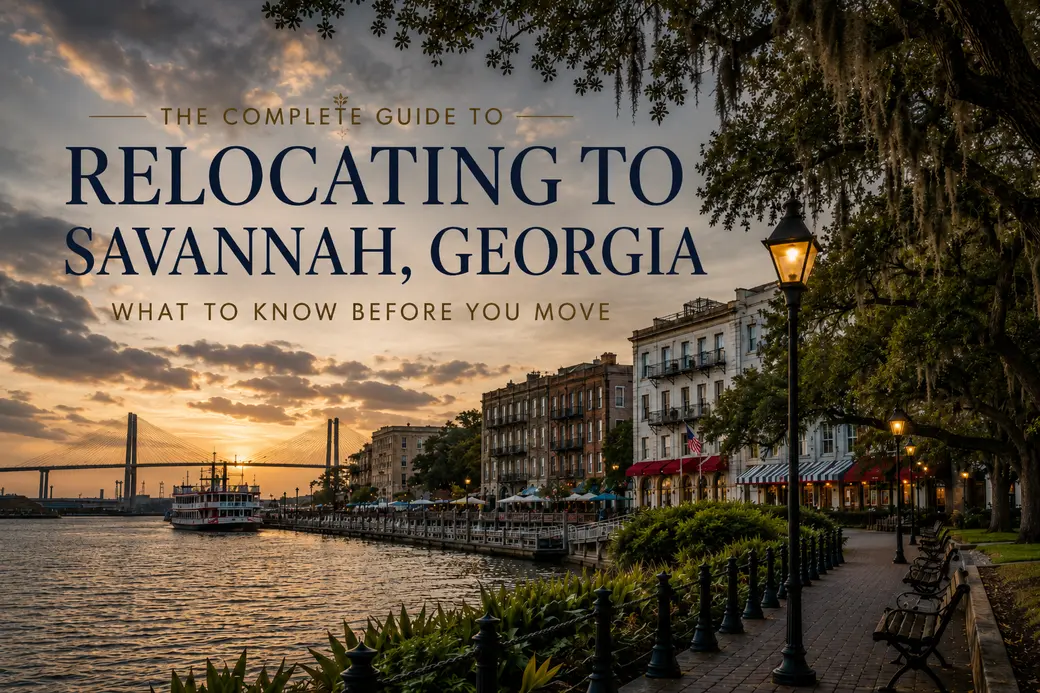
The Complete Guide to Relocating to Savannah, Georgia: What to Know Before You Move
Relocating to Savannah can begin with something as simple as a job opportunity, a visit that stayed with you, a desire to live closer to the coast, a military transfer, retirement plans or the realization that you are ready for a different pace of life.
Then the research starts.
Where should you live?
How far is everything from downtown?
Should you consider Savannah itself, the islands, Pooler, Richmond Hill or somewhere farther out?
What does flood insurance actually mean here?
What are the houses like?
How much do homes cost?
How difficult are the commutes?
What should you know about insurance, property taxes, schools, healthcare, new construction, older homes and hurricanes?
And perhaps most importantly:
How do you distinguish between a place that looks appealing online and one that will actually work for your everyday life?
That is what this guide is designed to help with.
Savannah is not one uniform housing market or one type of lifestyle. The Greater Savannah Area stretches across communities that can feel remarkably different even when they are separated by only a relatively short drive.
The right relocation decision usually begins not with finding a house, but with understanding the area well enough to know where you should be looking for one.
First: What Does “Savannah” Actually Mean?
This is one of the first things relocation buyers need to understand.
Someone may tell you they are moving to “Savannah” and ultimately purchase in the City of Savannah, on an island in Chatham County, in Pooler, in Richmond Hill in Bryan County, or in Rincon or Guyton in Effingham County.
All can reasonably be part of a Greater Savannah home search.
That is why simply searching “homes for sale in Savannah” can create more confusion than clarity.
The region includes distinctly urban, historic, suburban, coastal, gated, rural and newer-development environments.
A relocation search might include:
Savannah proper, including downtown, the Historic District, Victorian District, Starland, Midtown, Ardsley Park, Parkside, Southside and numerous other established neighborhoods.
The islands, including Wilmington Island, Whitemarsh Island and Skidaway Island.
The Landings on Skidaway Island, a large private residential community with its own association structure and a separate private golf and athletic club.
Pooler, west of Savannah and close to the airport, Interstate 95, Interstate 16 and significant commercial and employment development.
Richmond Hill, south of Savannah in Bryan County.
Rincon and Guyton, northwest of Savannah in Effingham County.
Tybee Island, Savannah's barrier-island beach community, which presents a very different combination of coastal ownership, insurance, flood and short-term-rental considerations.
There are additional communities throughout Chatham, Bryan and Effingham counties as well.
The point is not that one is better.
The point is that they solve different problems for different buyers.
Start With the Life You Want to Live
A relocation buyer can easily become distracted by houses.
The four-bedroom house with the beautiful kitchen starts driving the decision before anyone asks whether the buyer will enjoy living where that house is located.
I prefer to reverse that process.
Before narrowing the home search, I want to understand how someone expects to live once the boxes are unpacked.
Where will you work?
How often will you commute?
Will you work remotely?
How often do you fly?
Do you want to be near downtown Savannah?
Would you rather have coastal access or immediate interstate access?
Do you want a neighborhood where the homes have been there for generations, or does new construction appeal to you?
Would you enjoy living in a gated community?
Would you rather avoid significant community restrictions?
Is boating important?
Golf?
Restaurants?
Walkability?
A larger yard?
Lower-maintenance living?
Do you expect frequent visitors?
Are you moving from a much larger metropolitan area where a 45-minute drive feels normal, or from somewhere where everything is ten minutes away?
These questions may seem unrelated to real estate.
They are actually some of the most important real estate questions a relocation buyer can answer.
Understanding the Major Savannah-Area Choices
Downtown Savannah and the Historic Core
Savannah's downtown and historic neighborhoods are what many people picture when they first imagine moving here: historic architecture, public squares, mature trees, sidewalks, restaurants and centuries of architectural history concentrated into a relatively compact area.
Housing can include historic single-family homes, townhomes and condos, along with properties that have been substantially renovated and others that require considerable work.
Buying an older or historic Savannah property deserves a different type of evaluation than buying a five-year-old home.
Beyond cosmetic condition, pay attention to items such as electrical systems, plumbing, roofing, moisture, foundations, drainage, previous renovation work, permits when applicable, windows, termite history and structural changes.
Historic-district requirements may also affect what an owner can alter on certain properties.
A beautiful historic home can be an extraordinary property.
It should still be approached as a house with systems, maintenance requirements and ownership costs - not simply as architecture.
Midtown, Ardsley Park and Established Savannah
Moving south from downtown brings a different Savannah experience.
Midtown and surrounding established neighborhoods can offer mature trees, traditional streetscapes and housing built across several decades rather than the dense historic environment found downtown.
Ardsley Park is one of Savannah's best-known established residential areas and includes a broad mixture of architecture.
These areas can appeal to buyers who want character and established surroundings while remaining relatively connected to central Savannah.
Inventory can also vary considerably.
A renovated property and an unrenovated property only a few streets apart may attract very different buyers and command very different prices.
Wilmington Island
Wilmington Island is one of the areas I frequently discuss with relocation buyers who are interested in an island or coastal lifestyle without necessarily wanting a private gated community.
It sits between Savannah and Tybee Island and contains a wide range of established residential neighborhoods, waterfront and marsh-oriented properties, townhomes and other housing.
One of Wilmington Island's advantages from a relocation standpoint is that it provides a distinctly different residential environment while remaining connected to Savannah.
But island living should also prompt early conversations about flood information, insurance, drainage, wind exposure, and the specific property's location.
A buyer should evaluate the individual property, not make assumptions based simply on the word “island.”
Whitemarsh Island
Whitemarsh sits between Savannah and Wilmington Island and is another possibility for buyers looking east of the city.
Housing and community styles vary, and the location can offer an alternative for someone who likes the general island area but does not necessarily need to be farther east toward Wilmington or Tybee.
As with Wilmington Island, the correct comparison is property-specific.
Flood designation, HOA structure, condition, insurance and access should all be reviewed rather than inferred from the general location.
Skidaway Island and The Landings
Skidaway Island offers a different type of Savannah-area lifestyle.
The Landings is a large private residential community on Skidaway Island with neighborhood areas, extensive trails and a variety of settings that include wooded, lagoon, golf-course, marsh and waterfront properties.
One of the most important things relocation buyers need to understand is that The Landings Association and The Landings Golf & Athletic Club are separate organizations.
Property ownership involves the Association, while Club membership and its golf, dining, fitness and recreational amenities are separate.
The community is also large enough that location within The Landings matters. Gate access, proximity to particular amenities and the setting of the individual property should all factor into the search.
For a buyer interested in privacy, an established gated environment, coastal surroundings and optional private-club amenities, The Landings may deserve serious consideration.
For someone whose top priority is rapid interstate or airport access, another area may make more sense.
That is exactly why lifestyle comes before house selection.
Pooler
Pooler has become one of the most significant suburban and commercial areas in the Savannah region.
Its location provides relatively direct access to Savannah/Hilton Head International Airport, Interstate 95 and Interstate 16, and the broader western Chatham employment and logistics corridor.
Housing includes established communities as well as substantial newer construction.
For relocation buyers, Pooler may enter the conversation when priorities include newer housing, interstate access, airport convenience, nearby shopping or employment west of central Savannah.
There is no single “Pooler housing market,” however.
Communities, ages, amenities, lots and price points vary significantly.
New construction also creates competition for resale properties, something buyers should consider when evaluating both current value and eventual resale.
Richmond Hill
Richmond Hill is in Bryan County south of Savannah and has experienced substantial residential growth.
Buyers may encounter established neighborhoods, gated communities, newer subdivisions and ongoing new construction.
Its location can make sense for people whose work or lifestyle pulls them south of Savannah, including some military and industrial relocations.
However, Richmond Hill should not be chosen solely because a map shows it relatively close to Savannah.
A buyer who expects to travel into central Savannah every day should actually experience that route.
The same applies to someone commuting toward Fort Stewart or to employment elsewhere in Bryan County.
How a commute feels in daily life matters more than how short it looks on a map.
Rincon and Guyton
Rincon and Guyton bring Effingham County into the relocation conversation.
Buyers looking northwest of Savannah may find different combinations of lot size, new construction, established subdivisions and price points compared with Chatham County.
These areas may make sense for someone whose employment, lifestyle or housing priorities align with Effingham County.
As with Richmond Hill, commute testing is important.
A home that provides more space for the money may still be the wrong choice if its location conflicts with the buyer's daily routine.
Tybee Island
Tybee Island should be evaluated separately from nearly every other Savannah-area market.
It is a beach community, and ownership can involve coastal flood and insurance considerations that deserve early investigation.
For buyers considering short-term-rental use, additional due diligence is critical.
Tybee's short-term-rental rules have changed substantially, including restrictions affecting permits, zoning and transfers of certain existing rental certificates. Regulatory changes continued in 2026, making property-specific verification especially important.
A property successfully operating as a vacation rental for the current owner does not automatically establish that the next owner can continue the same use.
If rental income is part of the plan, begin with the property's legal and regulatory status before relying on projected income.
What Do Homes Cost Around Savannah?
The most useful answer is:
It depends enormously on where you are looking and what you are buying.
Broad median prices are useful for orientation, but they should never be treated as a valuation tool for an individual property.
Current median prices can vary significantly between Savannah, Pooler, Richmond Hill, Wilmington Island, Skidaway Island, Tybee Island, Rincon and Guyton.
Those differences demonstrate how misleading the phrase “the Savannah market” can be.
They also require context.
A short-term median can move dramatically when an area has relatively few transactions or an unusual mix of high- or low-priced sales.
Property type matters.
Condition matters.
Water access matters.
Neighborhood matters.
New construction matters.
Price segment matters.
Even within the same ZIP code, two groups of homes may be experiencing completely different market conditions.
For an actual purchase decision, I would rather analyze the micro-market surrounding the property than rely on a citywide median.
Savannah Is a Collection of Micro-Markets
This is one of the most important ideas for a relocation buyer to understand.
There is no single set of market conditions that applies evenly across The Greater Savannah Area.
One segment may have substantial inventory and seller concessions while another has relatively little inventory.
A newer Pooler home may be competing directly against builders offering incentives.
An updated Ardsley property may have relatively few close substitutes.
A Skidaway Island luxury property may need to be evaluated against homes with substantially different lot, view and renovation characteristics.
A Wilmington Island property may appeal to a completely different buyer pool than a similarly priced Richmond Hill house.
This matters when you are deciding:
What to offer.
How aggressively to negotiate.
Whether the asking price is supported.
Whether a home has been sitting for an unusual amount of time.
What concessions may be realistic.
And whether one property represents stronger value than another.
I prepare buyer-side comparable market information for this reason.
CMA analysis should not be something only sellers receive.
Getting Around Savannah: The Map Does Not Tell the Whole Story
Savannah is not a massive metropolitan area geographically, but drive times can be affected by the particular route you need to travel.
Bridge crossings, gate access, tourist traffic, school traffic, interstate traffic, road construction and simply being deep inside a large community can change a commute.
For relocation buyers, one of the most useful things you can do during a visit is drive your future life.
Do not only drive from showing to showing.
Drive from a potential home to your workplace.
Drive downtown.
Drive to the airport.
Drive to the grocery store.
Drive the route at the time of day you expect to use it.
If you are considering an island property, see what it feels like to leave the island and return.
If you are considering Richmond Hill, test the Savannah commute.
If you are considering Pooler, see how the commercial corridors feel during busy periods.
A location should work at 7:30 on a Tuesday morning, not just at 2:00 on a Sunday afternoon.
Savannah/Hilton Head International Airport
Frequent travelers should include airport access in the location decision.
Savannah/Hilton Head International Airport is located west of central Savannah and close to the Pooler area.
For someone flying several times each month, living west of Savannah may produce a very different airport experience from living deep on Skidaway Island or farther south.
For someone who flies several times a year, that difference may have very little importance.
Again, lifestyle decides the value of location.
Savannah's Employment Landscape
Savannah's economy extends well beyond tourism.
Major regional sectors include aerospace, logistics and distribution, advanced manufacturing, automotive manufacturing, healthcare, technology and other industries.
The Port of Savannah is a major logistics anchor.
Gulfstream Aerospace maintains significant manufacturing, research, completion and support operations in Savannah.
Automotive and advanced manufacturing growth west and south of Savannah has also expanded the geographic area relocation buyers may need to consider when choosing a home.
That is why employment location should come very early in the housing conversation.
Military Relocation to Savannah
Military relocation is an important part of the Greater Savannah market.
Hunter Army Airfield is located in Savannah, while Fort Stewart is southwest of Savannah near Hinesville.
A buyer assigned to Hunter and a buyer assigned to Fort Stewart may make very different housing decisions.
For a military relocation, I want to know the actual duty location before narrowing communities.
Other considerations may include:
-
PCS timing
-
VA financing
-
Commute
-
Expected time at the installation
-
Potential resale timeline
-
Whether the buyer may later convert the property to a rental
-
Closing coordination with orders and travel
-
The buyer's actual monthly comfort level
Healthcare in Savannah
Healthcare access may be a major relocation consideration for some buyers and relatively unimportant to others.
Savannah's major hospital systems include Memorial Health University Medical Center and St. Joseph's/Candler.
If regular access to a particular physician, medical facility or specialty is important, put that location into the same commute analysis you would use for work.
Do not assume every part of The Greater Savannah Area offers the same drive.
Schools: Research the Actual Address
School information is understandably part of many relocation searches, but it needs to be handled objectively and property-specifically.
Public-school districts in the region include Savannah-Chatham County Public School System, Bryan County Schools and Effingham County Schools.
Attendance boundaries can change.
That is why buyers should verify the individual property address using the applicable district's current tools rather than relying on an old listing or third-party website.
Georgia also provides official school and district performance information through state education resources.
A great starting point is niche.com.
Savannah Weather: What Newcomers Should Expect
If you are relocating from a cooler or drier part of the country, Savannah's climate will be an adjustment.
Summer is hot.
Humidity is real.
Air conditioning is not optional comfort - it is an important home system.
Savannah also has a long growing season, substantial vegetation and the maintenance realities that come with a warm coastal climate.
That affects homes too.
Heat, moisture, vegetation and storms make issues such as HVAC condition, drainage, exterior maintenance, roofs, moisture and pest management especially relevant.
Hurricane Season Is Part of Coastal Georgia Life
The official Atlantic hurricane season runs June 1 through November 30.
That does not mean Savannah experiences a hurricane every year.
It means homeowners should understand that tropical weather is part of owning property on the Georgia coast.
Before relocating, it is useful to learn:
How evacuation information is communicated.
Where important property documents are stored.
What your insurance covers.
Whether you have flood insurance.
How your home is protected.
What preparations are appropriate for the property.
Where you would go if evacuation became necessary.
Hurricane preparation is far easier when it begins before there is a storm on the map.
Flood Zones: Do Not Panic - Verify
Few relocation topics generate more confusion than flood zones.
Chatham County contains multiple FEMA flood designations.
Properties in certain higher-risk flood zones may require flood insurance depending on the property and financing.
But the phrase “Savannah floods” or “this is in a flood zone” is not enough information to make a purchase decision.
Investigate the actual property.
That may include:
-
Current flood-zone designation
-
Available elevation information
-
Whether the lender requires coverage
-
Cost of flood insurance
-
Property elevation and drainage
-
Prior known flooding or water intrusion
-
Location relative to water
-
Other property-specific factors
Also remember:
Flood risk does not stop at the line on a map.
Homeowners outside the highest-risk designations may still choose to purchase flood coverage.
Information rather than assumptions.
Get Homeowners Insurance Quotes Early
Insurance is one of the relocation issues that should be addressed much earlier than many buyers expect.
Do not wait until two days before your due-diligence period ends to learn that the roof, age of the house, claims history or coastal exposure materially affects your insurance premium.
When possible, I encourage buyers to obtain preliminary insurance information before making an offer or very early in the contract period.
Your Approval Amount Is Not Your Comfort Amount
A lender may tell you what you are qualified to borrow.
You need to know what you are actually comfortable spending.
Those two numbers do not have to match.
A relocation buyer should consider the complete monthly and annual ownership picture:
Mortgage.
Property taxes.
Homeowners insurance.
Flood insurance when applicable.
HOA or association assessments.
Private club costs if desired.
Utilities.
Landscaping.
Pool maintenance.
Repairs.
Commuting.
Future renovations.
A $600,000 home in one part of the Savannah market may have a significantly different cost of ownership from a $600,000 home somewhere else.
Property Taxes and Homestead Exemptions
Georgia property taxation is local, which means buyers should research the specific county and municipality rather than relying on a generalized online estimate.
Georgia provides homestead exemptions for qualifying owner-occupied primary residences, with applications handled through local jurisdictions.
Chatham County also has its own homestead programs, including the Stephens-Day Homestead Exemption for qualifying homeowners.
Rules, eligibility and filing deadlines should always be verified for the year in which you purchase.
One important relocation mistake is assuming the current owner's tax bill will automatically become your tax bill.
Do not build your affordability calculation around another owner's exemptions without understanding what will apply to you.
HOA, Condo and Community Documents Matter
The Greater Savannah Area includes everything from properties with virtually no community governance to highly structured private communities.
If you are buying into an HOA, condo or property owners association, review the documents.
Do not simply look at the monthly or annual fee.
Depending on the property, you may need to understand provisions involving:
Exterior modifications.
Landscaping.
Fences.
Parking.
Boats and recreational vehicles.
Leasing.
Pets.
Architectural approval.
Maintenance responsibilities.
Amenities.
Assessments.
Insurance.
Rental restrictions.
If there is a particular issue that matters to you, I can help locate the relevant section of the documents.
The goal is to discover restrictions before you own the property.
Buying an Older Savannah Home
Savannah has wonderful older housing.
Older does not mean problematic.
Renovated does not mean problem-free.
Look beyond appearance.
For older properties, you may be especially interested in understanding:
Electrical systems.
Plumbing.
Roof.
HVAC.
Windows.
Foundation or structural conditions.
Moisture.
Drainage.
Termite history.
Previous renovations.
Permits.
Additions.
Historic requirements when applicable.
A beautifully designed kitchen can distract buyers from the fact that the roof needs attention.
An outdated kitchen can distract buyers from the fact that the house has excellent systems.
The complete property matters.
Termites and Pest Management Are Worth Understanding
Buyers relocating from other parts of the country may not be accustomed to how seriously termite protection is treated in coastal Georgia.
Warm, humid conditions make termite history, inspections, treatments and bonds important parts of property ownership.
If a property has a termite bond, understand:
Who provides it.
Whether it transfers.
What it covers.
When it renews.
And whether there is documentation of previous treatment or damage.
This is not a reason to avoid older homes.
It is simply part of doing appropriate due diligence in this region.
Buying on the Islands
Island and coastal properties deserve a slightly different lens.
Beyond the normal inspection items, buyers should consider:
Flood information.
Drainage.
Roof condition.
Insurance.
Wind exposure.
Salt-air effects on exterior components.
Moisture.
Trees.
Docks or waterfront structures when applicable.
Boating access when relevant.
HOA or community restrictions.
The presence of marsh or water does not automatically make a property more or less desirable.
It changes what you need to understand.
Buying New Construction Around Savannah
Savannah, Pooler, Richmond Hill, Effingham County and surrounding areas continue to offer new-construction opportunities.
New construction can be very attractive to relocation buyers because it may offer modern floor plans, new systems, builder warranties and less immediate renovation work.
But new does not eliminate due diligence.
I want buyers to understand:
The builder contract.
Incentives.
Financing incentives.
Closing-cost offers.
Lot premiums.
Upgrade pricing.
HOA documents.
Warranty coverage.
Inspection opportunities.
Construction timeline.
Future phases.
What may eventually be built around the property.
Whether the builder is still actively competing against future resale listings in that community.
And one distinction matters:
The representative in the builder's sales office represents the builder.
A buyer can have their own real estate representation.
Ideally, that relationship should begin before the first model-home visit.
Buying in Georgia: Understand the Due-Diligence Period
Georgia real estate contracts may include a negotiated due-diligence period.
This period can be critically important.
It is when buyers may be working through inspections and other investigations permitted under their particular contract.
This is a working period, not a waiting period.
Depending on the property, that may mean investigating:
Home inspection findings.
Termite information.
HVAC.
Roof.
Plumbing.
Electrical.
Septic or well systems.
HOA documents.
Flood.
Insurance.
Survey issues.
Contractor estimates.
Property history.
Other property-specific concerns.
The neighborhood and surrounding area.
Exact rights and deadlines are governed by the contract, so legal questions should be addressed by the appropriate attorney.
The key practical point is simple:
Know your dates and use the time intentionally.
Inspections Always Find Something
Buyers sometimes become alarmed when they receive a long inspection report.
A long report does not necessarily mean the house is bad.
Inspectors document observations.
Our job afterward is to put those findings into context.
What is normal maintenance?
What is cosmetic?
What deserves further professional evaluation?
What could be expensive?
What could affect safety?
What might affect insurance?
What should be negotiated?
What can reasonably wait?
The goal is not to find a house with a completely blank inspection report.
That house probably does not exist.
The goal is to understand what you are buying.
Compare Homes With Data, Not Just Emotion
Before making an offer, understand the market around the property.
That can include:
Recent comparable sales.
Current competition.
Days on market.
Price changes.
Condition differences.
Lot differences.
Location.
Renovations.
Seller concessions when available.
Broader market movement.
I often prepare the buyer-side equivalent of the analysis sellers receive when pricing a home.
Buyers deserve that information too.
Think About Resale Before You Buy
Relocation buyers naturally focus on arriving.
I also want them thinking about leaving.
Not because I expect them to move again immediately.
Because life changes.
Jobs change.
Families change.
Military orders change.
Priorities change.
The property you purchase today may eventually need to appeal to another buyer.
That means paying attention to features that may affect future marketability.
Location.
Floor plan.
Condition.
Lot.
Insurance.
Flood considerations.
Community.
Road noise.
Nearby development.
Unusual property characteristics.
Historical market performance.
We cannot predict future value.
You can make today's decision with the future in mind.
What If You Need to Buy Before Selling Your Current Home?
Relocation frequently involves two real estate transactions instead of one.
That creates questions such as:
Do I sell first?
Can I buy first?
Where will I live between closings?
Can I make an offer contingent on the sale of my existing home?
Do I need temporary housing?
Would a rent-back help?
Are there Buy Before You Sell options available?
The best answer depends on the buyer's equity, financing, risk tolerance, timeline and the market on both sides of the move.
I prefer comparing the options rather than assuming everyone should follow the traditional “sell first, then buy” model.
Sometimes that is exactly the right answer.
Sometimes another structure makes the relocation much easier.
I have a vast Referral network with agents in every state. I can always help put you in touch with a great realtor in the city and state you are moving from.
Buying From Out of State
Not every relocation buyer can make repeated trips to Savannah.
Some cannot visit at all before purchasing.
That changes the process, but it does not mean the decision has to become guesswork.
For remote buyers, I may use:
Live video tours.
Detailed recorded walkthroughs.
Property records.
Seller disclosures.
HOA documents.
Maps.
Comparable sales.
Inspection reports.
Contractor evaluations.
Local professional referrals.
And when I am walking through a property by video, I am not interested in filming only the attractive parts.
If I see staining, I show it.
If a room is smaller than the photography suggests, I say so.
If there is road noise, I want you to hear it.
If the backyard backs up to something you did not realize was there, you should know.
My job is not to make the house look good on FaceTime.
It is to help you understand it.
How to Plan a Savannah House-Hunting Visit
If you can visit before buying, use the trip strategically.
I would rather show a relocation buyer fewer homes in carefully selected areas than drive through 25 houses scattered across three counties without learning anything.
Before the trip, we can narrow:
Budget.
Property type.
Space requirements.
Commute.
Preferred general areas.
New versus established.
HOA preferences.
Island versus Savannah.
Renovation tolerance.
Important amenities.
Then the visit can answer a different question:
Does what looked right online actually feel right in person?
A useful relocation visit should include more than showings.
Drive.
Explore.
Eat somewhere nearby.
See the grocery options.
Experience different routes.
Look at the surroundings.
Spend time in more than one area.
Sometimes a buyer arrives convinced that one part of Savannah is the answer and leaves preferring somewhere completely different.
That is not a failed trip.
That is a successful one.
What If You Only Have One Weekend?
Then prioritize decisions.
Do not try to learn all of Greater Savannah in 48 hours.
Before you arrive, narrow the search to perhaps two or three geographic possibilities based on your actual life.
Then use the weekend to compare those environments.
The objective does not necessarily have to be leaving town under contract.
It may be leaving town knowing:
“These are the two places where I would buy.”
That alone can dramatically improve a remote search afterward.
Moving Logistics After You Choose the House
Once the real estate decision is made, relocation becomes operational.
The exact checklist will depend on your move, but common tasks include:
-
Coordinate movers and delivery timing.
-
Confirm closing and possession dates.
-
Arrange homeowners and flood insurance as applicable.
-
Transfer or establish utilities.
-
Update mailing addresses.
-
Transfer medical and prescription records when needed.
-
Confirm school enrollment requirements when applicable.
-
Update banking, employer and insurance records.
-
Identify local service providers. I have a concierge service who can assist in setting everything up for you.
-
Secure important property documents and warranties.
-
Understand trash, recycling and local service schedules for the specific address.
-
Establish your Georgia driver's license and vehicle registration.
New Georgia residents should verify current state requirements for transferring an out-of-state driver's license and registering vehicles after establishing residency.
After Closing: Keep the Property Information
When you receive a stack of documents at closing, do not lose track of them six months later.
Create a home file.
Keep items such as:
Closing documents.
Survey.
Inspection reports.
Termite information.
Insurance information.
HOA documents.
Warranties.
Roof documentation.
HVAC records.
Contractor invoices.
Renovation permits.
Appliance information.
Service-provider contacts.
Over time, continue adding major maintenance and improvement records.
That information can be enormously valuable while you own the home - and if you eventually sell it.
Common Relocation Mistakes I See
The first is choosing a house before choosing an area.
The second is assuming The Greater Savannah Area behaves like one housing market.
The third is relying too heavily on online neighborhood descriptions without testing daily life.
The fourth is waiting too long to investigate insurance and flood considerations.
The fifth is comparing homes based only on purchase price.
The sixth is assuming new construction does not need inspections or buyer representation.
The seventh is assuming an older home is a problem simply because it is older.
The eighth is ignoring HOA documents until late in the process.
The ninth is using a lender's maximum approval as the target budget.
And the tenth is trying to learn everything at once.
A relocation buyer does not need every piece of Savannah information on day one.
You need the right information at the right point in the decision.
How I Work With Savannah Relocation Buyers
My relocation process begins before we start scheduling tours.
I want to understand:
Why you are moving.
When you need to be here.
Where you will work.
How you expect to spend your time.
What you are comfortable spending.
What you need in the property.
What you can compromise on.
What you absolutely cannot.
Then we narrow the geography.
Before an offer, we discuss the property in the context of the market.
During due diligence, we work through inspections and other investigations.
As closing approaches, I coordinate with the lender, closing attorney, inspectors, contractors and other professionals involved.
And after closing, I remain available.
Relocation does not magically end when the deed records.
Sometimes that is when the questions really begin.
Savannah Relocation FAQ
Is Savannah expensive to live in?
There is no useful yes-or-no answer without knowing where and how you plan to live.
Housing costs vary significantly throughout The Greater Savannah Area, and the full cost of ownership can also change based on property taxes, insurance, flood coverage, HOA assessments, private-club expenses and maintenance.
A buyer should compare complete ownership cost, not simply sale price.
How far is Savannah from the beach?
Tybee Island is Savannah's nearby Atlantic beach community. Travel time varies considerably based on where in The Greater Savannah Area you begin, traffic and time of year.
If frequent beach access matters, include the drive in your location decision rather than relying on a generic mileage estimate.
What areas are considered Greater Savannah?
A typical relocation search may extend through Savannah and surrounding portions of Chatham County as well as communities in Bryan and Effingham counties.
Depending on the buyer, that may include Savannah, Pooler, Wilmington Island, Whitemarsh Island, Skidaway Island, Richmond Hill, Rincon, Guyton and other surrounding areas.
Should I live downtown or in the suburbs?
That depends on what you value.
If proximity to Savannah's historic core and an established urban environment matter most, your search may lean toward Savannah itself.
If newer construction, interstate access, larger developments or other priorities matter more, Pooler, Richmond Hill or another surrounding area may enter the conversation.
Neither is inherently better.
Should I live on one of the islands?
Island living can be a strong fit for someone who values coastal surroundings and the locations work for their routine.
It also means property-specific flood, insurance and condition considerations should be investigated early.
Does every Savannah home require flood insurance?
No.
Flood-insurance requirements depend on factors including flood designation and lender requirements.
Even when insurance is not lender-required, buyers are encouraged to choose to obtain coverage.
Is Savannah good for new construction?
The Greater Savannah area offers significant new-construction inventory, particularly in suburban growth areas.
Whether new construction is the right choice depends on the buyer's priorities, location, community, builder terms, incentives, lot, timeline and eventual resale considerations.
Should I rent before buying?
For some relocation buyers, yes.
If you have never spent meaningful time in the Savannah area and remain unsure where you want to live, a temporary rental may provide valuable flexibility.
For others, work location, previous visits, financial considerations and a well-defined search make purchasing immediately reasonable.
There is no universal answer.
Can I buy a Savannah home without being there in person?
Yes, transactions can often be completed with substantial parts of the search and transaction handled remotely.
The more important question is whether you have enough reliable information to make the decision confidently.
Detailed virtual tours, property research, inspections, documents, insurance information and local professional support become especially important.
How early should I contact a real estate agent before relocating?
Earlier is usually better - even if you are not ready to buy.
An early conversation can help you understand geography, realistic housing options, financing, preparation and timing before you start making decisions around incomplete information.
You do not need to be arriving next week for the conversation to be useful.
What is the biggest thing relocation buyers misunderstand about Savannah?
That “Savannah” is a single location and a single real estate market.
It is neither.
The better we understand what you want your everyday life to look like, the easier it becomes to identify which part of The Greater Savannah area deserves your attention.
Final Thoughts
Savannah is easy to fall in love with.
That does not mean every part of The Greater Savannah area will be the right fit for every person who wants to move here.
And that is okay.
Relocation is not about finding the neighborhood someone on the internet says is best.
It is about matching your life, your budget, your priorities and your plans with the right location and then evaluating the individual property carefully.
Sometimes that points toward a historic Savannah home.
Sometimes Wilmington Island.
Sometimes The Landings.
Sometimes Pooler.
Sometimes Richmond Hill.
Sometimes somewhere a buyer had not considered before we started.
The goal is not to convince you to choose one.
The goal is to give you enough useful information to understand why you are choosing it.
That is what makes a relocation decision much easier to live with long after the moving truck is gone.
Get in Touch - 1 Click to Everything
Planning a move to Savannah? Contact Rachael for the Savannah Relocation Guide, local resources and help narrowing your search before you arrive.
Rachael Blunt is a Savannah-area REALTOR® with Epique Realty who works with relocation buyers throughout Savannah, Skidaway Island, Wilmington Island, Pooler, Richmond Hill and the surrounding Greater Savannah market. Her approach combines detailed property and market research, proactive communication and practical guidance to help buyers understand both the home they are purchasing and the community surrounding it.
This article is provided for general informational purposes. Real estate, tax, legal, flood, insurance, school-boundary and regulatory information can change and should be independently verified with the appropriate agency or qualified professional for the individual property and circumstances.
Categories
Recent Posts




GET MORE INFORMATION