

Project Camellia in Effingham County: What Homeowners and Buyers Should Know About the Planned OpenAI Data Center September 2026
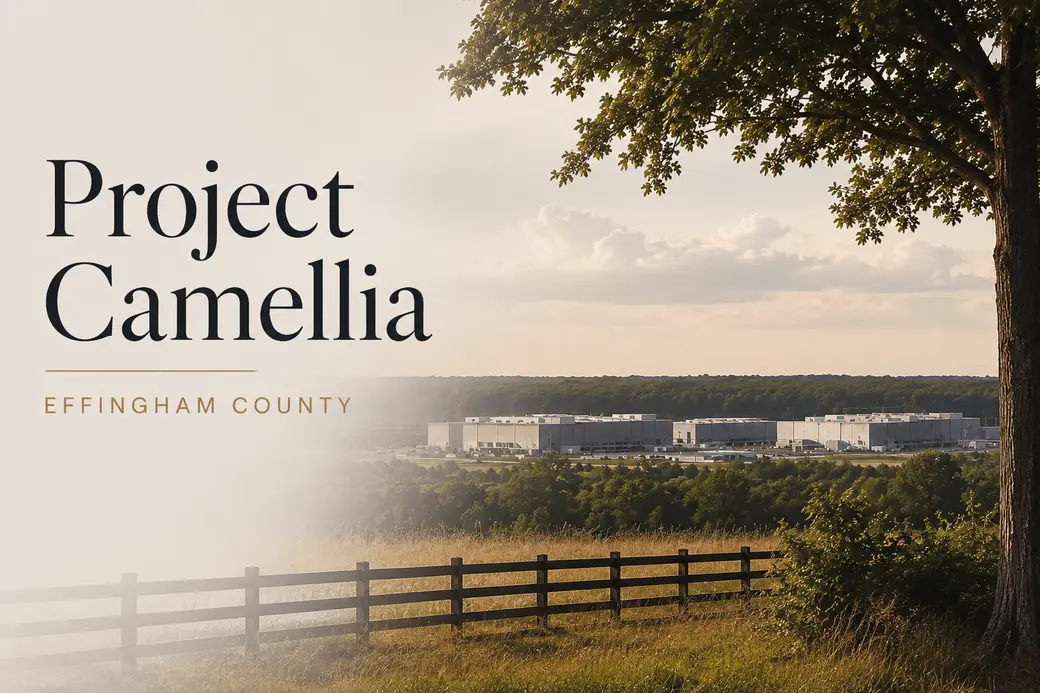
Project Camellia in Effingham County: What Homeowners and Buyers Should Know About the Planned OpenAI Data Center
Updated September 15, 2026
Project Camellia has moved quickly since it was first announced in July, and several important details have changed or become clearer.
OpenAI plans to establish a major artificial-intelligence data center campus within the existing Savannah Gateway Industrial Hub in Effingham County. Effingham County announced the project as a $20 billion capital investment expected to create approximately 400 long-term jobs, expand the local tax base and support infrastructure, education and workforce-development initiatives. Savannah Gateway Industrial Hub itself is an existing approximately 2,600-acre industrial and logistics campus.
Since the announcement, Effingham County has released additional information about water, power, noise mitigation, property taxes, local revenue and education funding.
There is also a significant new development as of September 14.
Project Camellia's site plan had been scheduled for consideration on September 15. According to Effingham County, the applicant has requested that consideration be postponed to a future date. The agenda item involved a site-plan application for Project Camellia at Gateway Parkway in Rincon.
That does not mean the project has been canceled.
It does mean the site-plan approval process is still active, and some of the details that matter most to nearby homeowners and buyers - including final building placement and site configuration - should not yet be treated as settled.
For anyone who owns property in Effingham County or is considering buying near Rincon, Guyton or the broader Savannah Gateway area, the useful question is not simply whether Project Camellia is coming.
It is:
What do we actually know today, what is still being reviewed, and what could matter for a specific property?
What Is Project Camellia?
Project Camellia is OpenAI's planned data center campus within the Savannah Gateway Industrial Hub.
Effingham County announced the project on July 22 as one of the largest private capital investments in coastal Georgia, with approximately $20 billion in investment and 400 long-term jobs.
The County has also tied the project to expected increases in local tax revenue, infrastructure investment and education and workforce-development opportunities.
The development is currently planned in five phases, with local revenue increasing as portions of the campus are completed.
One thing I am intentionally not treating as final is the total building square footage or exact campus configuration.
Different figures appeared earlier in the development process, and the site plan itself has not yet received the consideration that had been scheduled for September 15.
Until a final County-approved site plan is available, I think it is more accurate to focus on the information that has been formally reported and approved rather than speculate about final building dimensions.
For nearby homeowners, the eventual location of the buildings, roads, utilities and buffers may ultimately matter more than the total square footage anyway.
Is Project Camellia Fully Approved?
No.
The project is moving forward through the development process, but Effingham County has been clear that additional reviews, permits, approvals and inspections remain.
The County has identified review areas including:
-
Development of Regional Impact review
-
Water and sewer
-
Setbacks and buffers
-
Stormwater
-
Wetlands
-
Utilities
-
Erosion control
-
Building requirements
-
Fire safety
-
Construction inspections
-
Final Certificate of Occupancy
Each step provides another level of review before the campus can ultimately operate.
And the newest development reinforces that distinction.
On September 14, Effingham County announced that the applicant requested postponement of the September 15 consideration of the Project Camellia site plan to a future date.
So while Project Camellia is clearly an active project, the site-development process is not finished.
The August 29 Project Camellia Work Session
The County's August 29 Project Camellia Work Session has now occurred.
The session gave residents an opportunity to hear more about the history of the project, mitigation measures, anticipated community benefits and concerns surrounding the development.
Effingham County has since made the presentation and meeting materials available through its Public Meetings Document Hub.
For anyone following Project Camellia closely, those County materials are a useful source because this project is continuing to evolve.
Where Is Project Camellia?
Project Camellia is planned within the existing Savannah Gateway Industrial Hub in Effingham County.
The location matters because Savannah Gateway was already planned and operating as an industrial and logistics area before OpenAI's project was announced.
That does not make the effects of Project Camellia irrelevant to surrounding property owners.
It does provide important context.
This is not a previously planned residential tract that was suddenly converted into an industrial campus. Industrial development in this area predates Project Camellia.
At the same time, residential development also exists within the broader area, which is why the final site plan, roads, buffers, utilities and construction activity are particularly relevant for nearby properties.
Why the Final Site Plan Matters So Much
When someone says a house is “near Project Camellia,” that tells me very little by itself.
For a real-estate decision, I would want much more specific information.
How far is the property from the actual campus buildings?
Which direction will those buildings face?
What sits between the property and the development?
Where will the roads go?
Where will major utility infrastructure be located?
What existing vegetation will remain?
Will the project be visible from the property?
What will the completed noise study show?
How will construction traffic reach the site?
Those are property-specific questions.
Two houses within the same general area could have very different relationships to Project Camellia.
That is why I would not make a blanket statement about every home in Rincon, Guyton or even every home near Savannah Gateway.
What Does Effingham County Say About Water?
Water has been one of the most discussed issues surrounding large data-center developments.
Effingham County says Project Camellia will use a closed-loop cooling system.
According to the County, the system fills once and continuously recirculates the same water rather than relying on an evaporative cooling system that requires an ongoing supply of new water.
The County also says the project will use treated surface water only - not groundwater from the Floridan aquifer.
Formal safeguards in the County's water and sewer agreement are expected to establish water quantities, conditions and protections for community water needs.
Once the campus is operating, actual water-use data is expected to be made public and included in an annual independent audit.
That gives us substantially more information than we had when Project Camellia was first announced.
It is still something worth monitoring as the project moves from planning into construction and eventually operation.
What Does the County Say About Electricity?
The amount of power required by modern data centers has also generated understandable questions.
Effingham County says that under Georgia Public Service Commission requirements, large-load customers such as Project Camellia are responsible for the electric infrastructure and service necessary to support their operations.
The County says existing Georgia Power customers are not expected to subsidize those infrastructure costs.
Project Camellia is also being designed to reduce its own power demand during periods of high grid stress.
The County has additionally cited a Georgia Public Service Commission agreement expected to save the typical Georgia Power residential customer approximately $102 annually beginning in 2029, driven in part by revenue associated with large-load growth.
The larger question of how rapidly increasing data-center demand affects Georgia's power system will continue to develop well beyond this single project.
What Does the County Say About Noise?
Noise may be one of the most important issues for properties closest to Savannah Gateway.
Effingham County published a dedicated Project Camellia noise update on August 27.
According to the County, current plans include several specific measures.
Power generation is planned offsite
Project Camellia plans to keep power generation offsite.
The County also says no diesel backup generators are planned for use after the project is complete.
A minimum 300-foot vegetative buffer is planned
Current plans include a minimum 300-foot vegetative buffer along neighboring non-industrial properties.
The County says setbacks will exceed minimum requirements wherever possible and existing vegetation will be preserved where feasible to provide additional separation and help reduce noise and visual impacts.
Because the site-plan process is still underway, I would continue to describe this as the current plan rather than a completed physical condition.
A noise study will be required before operation
Effingham County says the facility must conduct a noise study before operation and comply with the County's existing Noise Control Ordinance.
That ordinance provides measurable sound standards and enforcement procedures.
Noise is expected to be monitored after opening
OpenAI has also committed to installing noise-monitoring equipment around the perimeter of the campus and providing regular noise-data updates after the facility begins operating.
For someone evaluating a specific home near the industrial hub, that eventual noise data will be much more useful than assumptions about what a data center may or may not sound like.
What About Visual Impact?
The planned vegetative buffers and preservation of existing vegetation are intended to provide separation and reduce both noise and visual impacts.
But whether Project Camellia will actually be visible from a particular house cannot be answered from a general County statement.
That depends on things such as:
-
Exact building placement
-
Property elevation
-
Campus elevation
-
Existing trees
-
Final buffers
-
Utility infrastructure
-
Road placement
-
Distance
Again, the final site plan matters.
What About Traffic?
Traffic really has two components.
Construction traffic
Building a campus of this scale will involve workers, contractors, materials and equipment over an extended period.
For nearby property owners, construction routes and construction timing may matter considerably.
Long-term traffic
The operating campus may create a different traffic pattern than the construction phase.
That is something we will understand better once the site plan, access points and operating details are further developed.
There is also a broader transportation issue that predates OpenAI.
Effingham County's 2025 Master Transportation Plan already identified substantial road and freight improvements in this part of the County, including upgrades to Blue Jay Road between Effingham Parkway and McCall Road, Blue Jay Road between McCall and Sandhill roads, McCall Road improvements and a potential east-west connector between Hodgeville Road and McCall Road.
That is important context.
The Savannah Gateway area was already expected to experience industrial and transportation growth before Project Camellia was announced.
Project Camellia adds another major development to that story.
It did not create the entire growth pattern.
The Property-Tax Story Has Changed Considerably
This may be the biggest homeowner update since the original article.
When Project Camellia was first announced, approximately six mills of property-tax relief was being discussed but had not yet been completely adopted.
That has changed.
Effingham County announced on September 2 that the 2026 rates and millage changes are now official.
The County reports:
-
A 2-mill County reduction
-
A 2-mill School District reduction
-
Suspension of the ECIDA's 2-mill levy
That equals six mills of local property-tax relief. (Effingham County)
For qualifying homeowners, the County says those changes - combined with a separate $500 State of Georgia grant for qualifying homestead properties - are expected to produce an average reduction of approximately 30% compared with 2025 property-tax bills.
Actual savings will vary based on assessed value, exemptions, taxing districts and other factors.
Non-homestead properties also receive the six mills of local relief, which the County estimates at roughly a 20% overall property-tax reduction.
There is one additional detail worth noting.
According to the County, OpenAI voluntarily agreed to pay property taxes based on the millage rates in place before the 2026 rollback, so its tax contribution is not reduced by the new property-tax relief measures.
That is a meaningful change from where this conversation stood in August.
The six-mill reduction is no longer merely proposed.
It has been adopted.
How Will Project Camellia Generate Local Revenue?
Effingham County has also released substantially more information about Project Camellia's PILOT - Payment in Lieu of Taxes - structure.
According to the County, local revenue begins in 2027 and increases as the campus is developed.
The project is planned in five phases. As a phase is completed, that portion begins generating PILOT revenue. Undeveloped portions continue paying taxes based on their existing assessed land value until development occurs.
Current County projections based on the minimum $20 billion investment are:
2027: approximately $2.5 million for Effingham County and $3.5 million for the Effingham County School District.
2029: approximately $10 million annually for the County and $14 million annually for the School District.
2032 full buildout: approximately $27 million annually for Effingham County and $39 million annually for the School District.
Those are projections - not guarantees.
Effingham County specifically notes that actual revenue will depend on the project's eventual investment and development.
What About Schools and Other Community Benefits?
The County released additional information on September 9.
According to Effingham County, OpenAI has committed $80 million in community benefits over the life of the project.
That commitment includes a $4.3 million grant covering student meals for the 2026–27 school year, according to the County's current Project Camellia update.
The County also describes potential education and workforce-development initiatives involving STEM and AI education, work-based learning, apprenticeships and career pathways.
Buyers should verify school assignments using the specific property address and current school-system information rather than relying on general neighborhood assumptions.
Will Project Camellia Increase or Decrease Home Values?
We still do not know.
And that is not avoiding the question.
It is the most accurate answer available today.
Project Camellia is not operating yet.
The site-plan process is still underway.
We do not yet have Project Camellia-specific sales history showing how buyers will respond to homes at different distances from the campus once it is built.
Real-estate values are affected by many things:
-
Supply
-
Buyer demand
-
Interest rates
-
Property condition
-
Location
-
Taxes
-
Infrastructure
-
New construction
-
Surrounding land uses
-
Buyer perception
Project Camellia could become one factor for certain properties.
It will not be the only factor.
Could Individual Properties Be Affected Differently?
Absolutely.
That is why I think the property-specific analysis is much more useful than a countywide prediction.
Consider two homes.
One is several miles from Savannah Gateway with no direct view, sound or traffic relationship to the campus.
Another sits much closer to the industrial boundary, a future access road or utility infrastructure.
A buyer could evaluate those two properties differently.
That does not mean we know what the price difference will be, if any.
It means the relationship between the individual property and the project matters.
For homes closest to Savannah Gateway, I would pay particular attention to:
-
Actual distance from the future buildings
-
Final building orientation
-
Vegetative buffers
-
Visibility
-
Completed noise-study results
-
Construction routes
-
Permanent road access
-
Electrical and other utility infrastructure
-
Stormwater plans
-
Other industrial development surrounding the property
-
Actual comparable home sales as the project develops
That gives us something measurable.
What Should Buyers Do Before Purchasing Near Project Camellia?
I would add another layer of due diligence.
Do not look only at the house.
Look at what surrounds it.
Review the property's exact location relative to Savannah Gateway.
Review surrounding zoning.
Understand which nearby parcels are industrial.
Follow the County's current Project Camellia information.
Review the eventual site plan when it is approved.
Look at planned roads and access points.
Review the buffers.
Read the noise study when it becomes available.
Understand the location of utility infrastructure.
And compare recent home sales in the immediate area.
Then decide whether that particular property works for your goals.
The objective is not to tell someone whether they should or should not live near Project Camellia.
The objective is to make sure they know what they are buying and what is planned around it.
What Should Existing Homeowners Do?
I would not make a major real-estate decision based on a headline.
If you own close to Savannah Gateway, I would start by establishing a baseline.
Know approximately what your home is worth today.
Watch neighborhood inventory.
Track days on market.
Watch pricing.
Monitor seller concessions.
Pay attention to comparable sales.
Follow the County's official project updates and final site-plan process.
If buyer behavior changes as Project Camellia progresses, the market data should eventually begin showing us that.
That is far more useful than trying to predict today what a buyer may think three or five years from now.
What We Know Today - and What We Still Don't
As of September 14, we know considerably more about Project Camellia than we did in July.
We know the County has adopted six mills of local property-tax relief.
We now have a County-published five-phase PILOT structure with revenue projections beginning in 2027.
We have additional County information about water, electricity, noise, buffers and monitoring.
The August 29 work session has taken place.
Additional education and community-benefit commitments have been announced.
And today we learned something else important:
The applicant has postponed the September 15 consideration of the Project Camellia site plan to a future date.
That means there are still meaningful pieces of this development that are not final.
We do not yet have an operating campus.
We do not yet have actual operating noise.
We do not yet have long-term traffic patterns.
We do not yet have actual water-use figures.
And from a real-estate standpoint, we do not yet have enough buyer behavior to reliably measure an effect on nearby home values.
Frequently Asked Questions About Project Camellia
What is Project Camellia?
Project Camellia is OpenAI's planned data center campus within the Savannah Gateway Industrial Hub in Effingham County. Effingham County announced approximately $20 billion in investment and about 400 long-term jobs.
Is Project Camellia fully approved?
No. The project is moving through County and state review, permitting and inspection processes. In addition, the applicant requested postponement of the September 15, 2026 site-plan consideration to a future date.
Has Project Camellia been canceled because the site plan was postponed?
The County's September 14 notice does not say the project was canceled. It says the applicant requested postponement of the site-plan approval consideration to a future date.
Will Project Camellia use the Floridan aquifer for cooling?
According to Effingham County, no. Current plans call for treated surface water and a closed-loop cooling system.
Is there a 300-foot buffer?
According to the County's current plans, yes. The project includes a minimum 300-foot vegetative buffer along neighboring non-industrial properties, with greater setbacks where possible.
Will there be diesel backup generators?
Effingham County says no diesel backup generators are planned for use after the project is complete, and power generation is planned offsite.
Will noise be monitored?
Yes, according to current County information. A pre-operation noise study will be required, and OpenAI has committed to perimeter monitoring and regular noise-data updates after operation begins.
Has the property-tax reduction been approved?
Yes. Effingham County says the 2026 changes have been adopted, including a 2-mill County reduction, 2-mill School District reduction and suspension of ECIDA's 2-mill levy.
How much could qualifying homeowners save?
The County says qualifying homeowners are expected to see an average reduction of approximately 30% compared with their 2025 property-tax bills, although actual savings depend on property value, exemptions and other factors. That average also includes a separate $500 State of Georgia grant for qualifying homestead properties.
When will Project Camellia begin generating local revenue?
Effingham County says revenue begins in 2027 and increases as the five phases are developed.
Will Project Camellia hurt home values?
There is not enough Project Camellia-specific sales evidence to answer that today.
For homes closest to the project, I would evaluate the specific property's distance, visibility, roads, planned buffers, surrounding land uses and eventual noise information - and then watch actual market behavior as development progresses.
Final Thoughts
Project Camellia is still a developing story.
But compared with where we were when the project was first announced, we now have considerably more factual information.
Some issues that were uncertain in August have become clearer.
Property-tax relief has been adopted.
The County has released more detailed financial projections.
We know more about planned water use, electrical infrastructure, noise mitigation and buffers.
We have the August 29 work-session materials.
And now, as of September 14, we know that consideration of the site plan has been postponed to a future date.
That last update is particularly important.
It reminds us that although Project Camellia is moving forward, the final physical development of the site is still going through the process.
From a real-estate perspective, I do not think the right response is to declare Project Camellia either good or bad for property values.
The better approach is to keep separating confirmed information from assumptions.
Know where a property is.
Know what surrounds it.
Understand what is already zoned and planned nearby.
Follow the County's official documentation as Project Camellia progresses.
And when it comes to home values, watch what actual buyers do.
That is where the useful answer will ultimately come from.
Rachael Blunt is a Savannah-area REALTOR® with Epique Realty who works with buyers, sellers and relocation clients throughout Greater Savannah, including Effingham County, Rincon and Guyton. Her approach emphasizes property research, zoning and development awareness, historical and current market data, and helping clients understand the complete picture surrounding a property before making a decision.
This article reflects publicly available information reviewed through September 14, 2026. Effingham County reports and County documents were used as the primary factual source. Project Camellia remains in an active development and review process, and site plans, projections, infrastructure details and other information may change. Real-estate observations are provided for informational purposes and are not guarantees of future property values.
Categories
Recent Posts



GET MORE INFORMATION